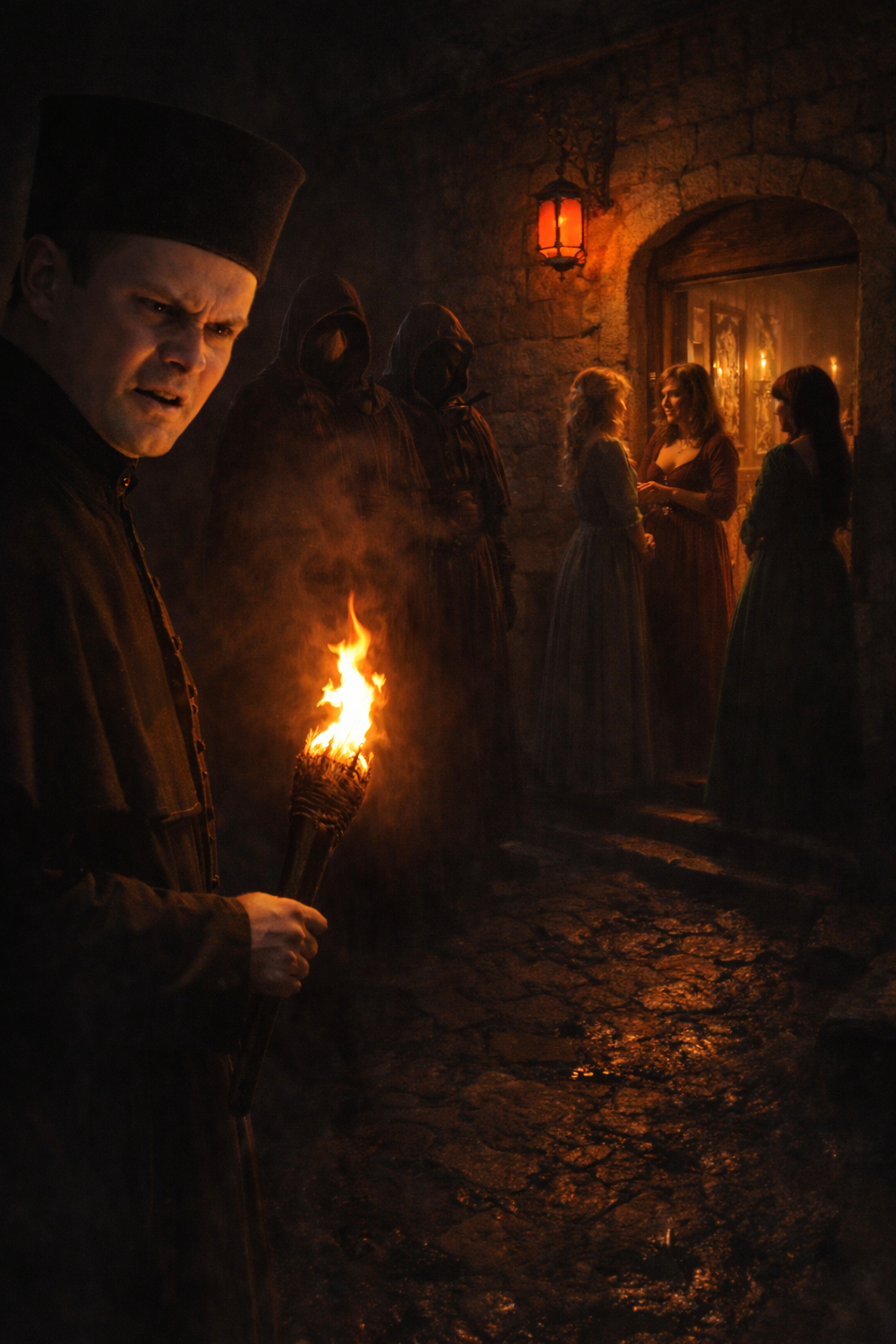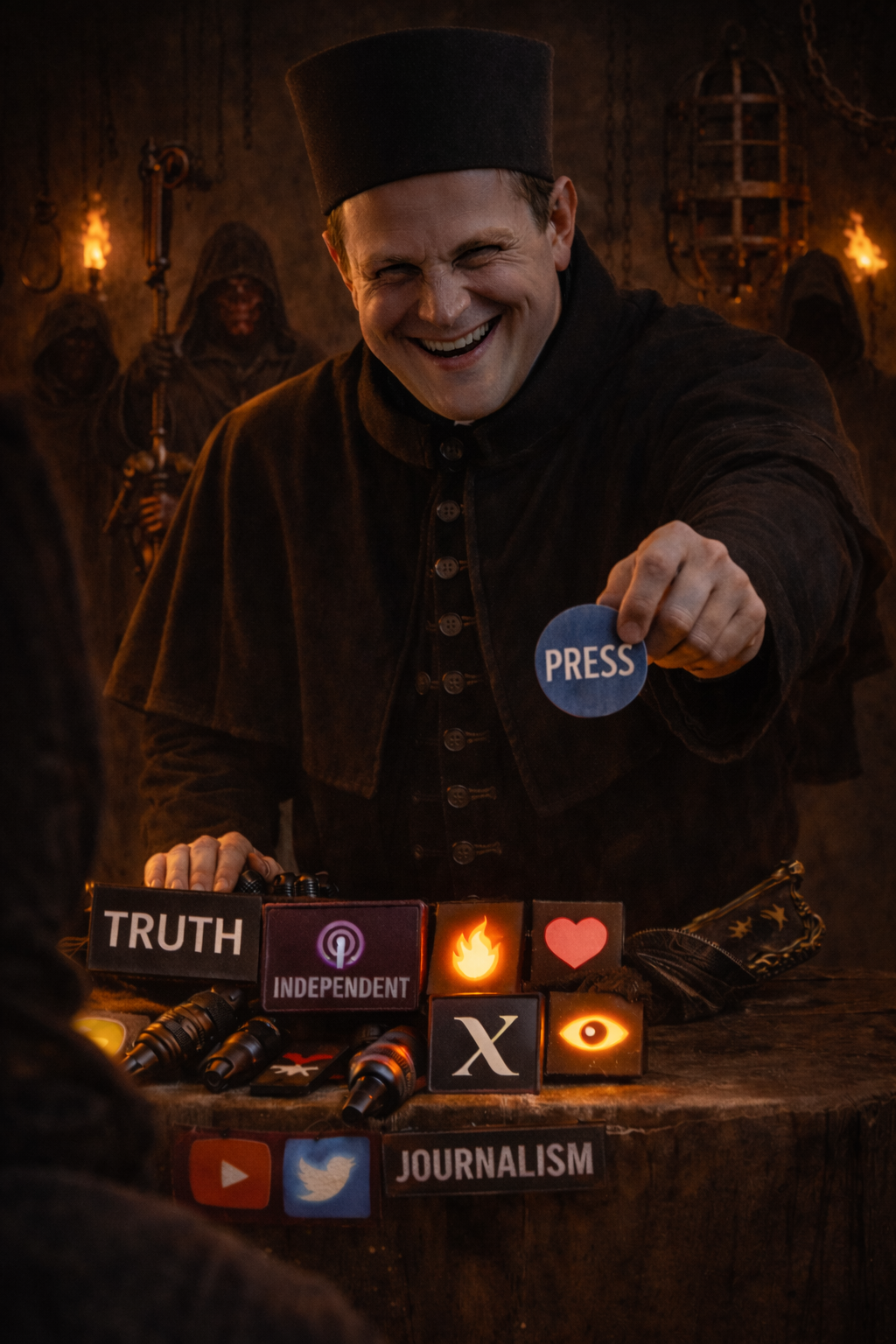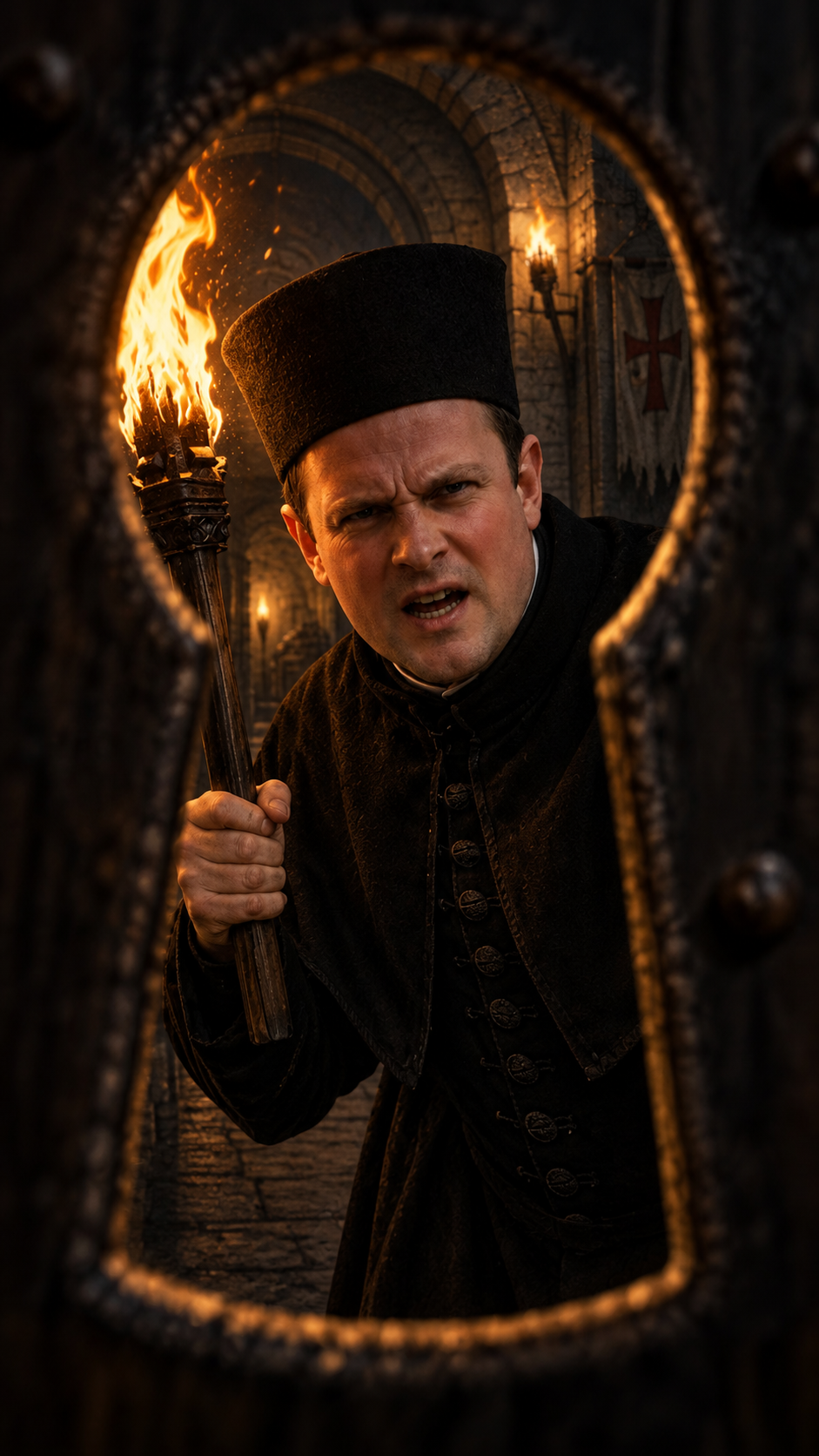
Paul Mulholland has spent years asking the public to take his investigations seriously. Now his public X account appears to be protected from non-followers, just as uncomfortable questions are emerging about a man in his research orbit whom Mulholland himself has publicly described as a “LARPer.” Maybe there is an innocent explanation. But when your business is investigating everybody else, people are allowed to investigate you too.
The Inquisitor Suddenly Wants Privacy
There is something genuinely strange about watching someone spend years presenting himself as an investigator of other people’s conduct, associations, statements and histories, only to eventually pull the curtains across his own public social-media account.
Paul Mulholland’s X account, @Paulisconi, now appears to be protected from people who do not already follow him. That is obviously his right. Nobody is arguing that a person loses the ability to use a privacy setting because he calls himself a journalist. But it is also perfectly reasonable to ask why, particularly because Mulholland has never exactly presented himself as someone uninterested in public scrutiny. His journalism, commentary and online activity have depended substantially on public attention, public allegations, public arguments and public examination of other people’s histories.
So when someone who spends his time investigating everyone else suddenly makes his own historical commentary harder to examine, the obvious reaction is not outrage. It is curiosity.
Why now?
And is the timing connected in any way to the increasingly strange public behavior of Alexander Elijah Barber, a person who appears to have been close enough to Mulholland’s research world that Mulholland eventually felt compelled to publicly distance himself from Barber’s claims?
“But He’s a Journalist” Is Not Evidence
People have a natural tendency to believe that once somebody calls himself a journalist, or publishes something formatted like journalism, some invisible layer of credibility automatically attaches itself to the work. It shouldn’t.
Most journalists presumably want to get their stories right, and outright fabrication remains an extreme form of misconduct. But journalism has also produced enough spectacular fabrication scandals that readers should understand a very simple principle: a professional title, prestigious publication, polished article or award is not evidence that every claim inside a story is true.
Janet Cooke of The Washington Post invented “Jimmy,” the eight-year-old heroin addict at the center of a story that won the Pulitzer Prize. The story collapsed, Cooke admitted fabrication, and the Pulitzer was returned. Stephen Glass manufactured characters, quotations, events and supporting material for stories published in The New Republic and elsewhere. Jayson Blair produced fabricated and plagiarized reporting at The New York Times, sometimes describing places and interviews in ways that suggested firsthand reporting that had never occurred. Claas Relotius became an acclaimed reporter at Der Spiegel before it emerged that substantial portions of his celebrated reporting had been fabricated.
These cases are important because the people involved were not publishing anonymous conspiracy posts on obscure message boards. They were producing journalism through respected institutions, sometimes with editors, reputations and awards behind them.
The point is not that journalists should automatically be distrusted. The point is that the word “journalist” proves nothing by itself.
Journalism becomes trustworthy when the evidence survives scrutiny.
Editors can be fooled. Publications can be fooled. Award committees can be fooled. Readers can certainly be fooled. And journalists themselves remain ordinary human beings subject to the same incentives as anyone else: attention, career advancement, recognition, ideology, competition and the temptation to possess the story nobody else has.
Then You Look at Alexander Elijah Barber
That brings us to the much stranger problem surrounding Mulholland.
The public material attributed to Alexander Elijah Barber does not exactly present the image of a quiet researcher carefully passing verified documents to a reporter and disappearing into the background. His public persona appears much more theatrical. He has publicly associated himself with intelligence-style terminology, extraordinary theories and communications directed toward major institutions and military accounts, including CENTCOM.
Does that make him an intelligence operative? No.
Does it prove anything about whether an individual claim is true? No.
But does the public persona appear designed to attract attention and project the image of someone operating inside a much larger intelligence or counter-intelligence story?
It is difficult to look at the presentation and not at least ask that question.
That becomes considerably more important because Mulholland himself eventually rejected extraordinary intelligence claims associated with this material. In a public response, Mulholland reportedly said there was no evidence supporting the suggestion that a person connected to his reporting worked in government intelligence. He also said the person advancing the claims was not employed in intelligence, was not law enforcement, was not a journalist and possessed no insider information about investigations.
Then Mulholland used the phrase that makes the entire relationship worth examining:
He is “LARPing.”
Mulholland also complained that unsupported personal theories were being attached to his journalism in a way that seemed to borrow credibility from his work.
That is not a trivial disagreement over interpretation. It is Mulholland himself saying that somebody within his broader orbit was presenting himself as possessing a type of knowledge or access that Mulholland did not believe he actually possessed.
Attention Is a Research Problem
Nobody can prove another person’s private motivation by scrolling through social media, so I am not going to pretend we can climb inside Barber’s head and establish why he posts the things he posts. But journalists evaluate source motivation all the time, and public behavior matters.
If a source appears deeply invested in being seen as important, connected, knowledgeable or central to a dramatic story, that is something a responsible reporter should consider when evaluating information from that source.
Attention can contaminate research.
A person who believes he has uncovered an enormous hidden conspiracy has an incentive to keep discovering connections. A person who enjoys presenting himself as an intelligence-adjacent investigator has an incentive to interpret ambiguous information dramatically. Someone who wants recognition for uncovering something nobody else has noticed can gradually become more confident in connections that exist mainly because he wants them to exist.
That does not mean everything such a person discovers is false. In fact, that is exactly what makes the problem difficult.
Someone can find genuine documents and still draw absurd conclusions from them. Someone can identify real people and invent relationships between them. Someone can locate authentic records and then construct an unsupported theory around those records.
That is where the journalist is supposed to become the filter.
And Mulholland’s own description of Barber’s later conduct raises the obvious question of how effective that filter was earlier.
How Far Back Does the LARP Go?
If Mulholland now believes Barber was “LARPing” about intelligence information, when exactly did that tendency begin?
Did Barber suddenly become unreliable after Mulholland’s reporting had already been published? Did his theories gradually become more extreme? Was there a clear moment where ordinary research turned into fantasy, or were plausible claims and dramatic speculation mixed together from the beginning?
That distinction matters enormously.
Imagine a researcher supplies a journalist with twenty pieces of information. Fifteen seem mundane, three seem interesting and two sound completely bizarre. The journalist rejects the two bizarre claims.
Wonderful.
But what happened to the other eighteen?
Were they independently verified from primary records? Did they come from screenshots whose origins were checked? Did the researcher supply names, aliases, companies, websites, timelines or supposed relationships that then shaped the direction of the investigation? Did one accurate discovery increase confidence in later material that received less scrutiny?
This is precisely how questionable research can influence a story without somebody literally inventing an entire article.
The problem can begin much earlier, at the stage where someone decides which people matter, which relationships deserve attention, which documents look suspicious and which interpretation ties everything together.
Once that framework takes hold, every new piece of information gets interpreted through it.
This Is Why the Famous Fabrication Cases Matter
The historical journalism scandals are relevant here not because Paul Mulholland has been proven to have fabricated anything. He has not.
They matter because they demonstrate how dangerous it is to treat journalistic status as a substitute for verification.
Stephen Glass did not walk into The New Republic and announce that he was about to fabricate material. Janet Cooke did not attach a disclaimer explaining that her central subject did not exist. Jayson Blair did not place a warning above his stories admitting that portions of his reporting were deceptive. Claas Relotius produced work polished and persuasive enough to receive enormous professional acclaim before the underlying problems became undeniable.
Fabrication succeeds when false or exaggerated material is packaged inside something readers already trust.
That lesson applies far beyond outright fabrication. It applies to sourcing, selective framing, confirmation bias, unreliable collaborators and theories that gradually become assumptions.
The proper response is not paranoia.
It is verification.
Mulholland’s Problem Is Bigger Than Barber’s Weirdest Claims
Paul Mulholland was absolutely entitled to reject an intelligence allegation if he concluded there was no evidence supporting it. In fact, that is what a journalist should do.
The problem begins immediately afterward.
Once you publicly tell readers that someone associated with your work has been promoting unsupported theories, claiming knowledge he does not possess and “LARPing,” readers are entitled to know whether that same person previously contributed information to your reporting.
Maybe Barber supplied nothing important.
Maybe his involvement consisted entirely of sending publicly available links.
Maybe Mulholland independently verified every useful piece of information and discarded every unsupported theory.
Maybe critics have exaggerated the nature of the relationship.
All of those possibilities remain open.
But they are questions of fact, not faith.
What did Barber supply? What information entered the reporting process? What did Mulholland independently verify? When did Mulholland first become concerned that Barber was attaching unsupported theories to his work? Did Mulholland go back and review earlier material once those concerns became obvious?
Those are not hostile questions.
Those are exactly the questions a journalist should ask about somebody else’s investigation.
And Then the Account Goes Private
This is where Mulholland’s protected X account becomes interesting.
Again, protecting the account does not prove why he did it. There may be an explanation completely unrelated to Barber, the Reddit dispute or any criticism of Mulholland’s reporting.
But a previously public social-media archive can be valuable when trying to reconstruct a relationship.
Old tweets could potentially establish how Mulholland publicly described Barber, how frequently they interacted, what material was circulated, which theories appeared at which times, when disagreement emerged and whether Barber’s supposed intelligence knowledge was ever treated differently before Mulholland publicly rejected it.
Chronology matters.
Anyone who performs investigative work understands this.
Researchers examine old Facebook posts, archived websites, deleted tweets, corporate filings, historical biographies and old public statements precisely because they allow the investigator to reconstruct what happened before everyone involved knew what would later become controversial.
That methodology cannot suddenly become unfair when the researcher himself becomes the subject.
Mulholland is perfectly entitled to protect his account.
But readers are equally entitled to notice that doing so makes an already relevant historical record more difficult to inspect.
You Don’t Get a One-Way Magnifying Glass
This is ultimately the contradiction at the center of the entire situation.
Investigative journalism depends upon scrutiny.
A reporter looks at relationships. He checks what people said years ago. He examines who communicated with whom. He compares timelines. He looks for contradictions between old statements and new explanations.
That is legitimate journalism.
But the magnifying glass works both ways.
If the executive of a company Mulholland was investigating had an associate publicly behaving as though he were involved in international intelligence operations, and that executive later announced that the associate was merely “LARPing” and had a habit of attaching unsupported theories to the executive’s work, would Mulholland stop asking questions?
Probably not.
He would likely want to know who the associate was, what access he had, what information he provided, how long the relationship lasted and whether any decisions were influenced by him.
That is essentially what people are entitled to ask Mulholland now.
Not because being associated with an eccentric person proves wrongdoing.
Not because every strange internet post invalidates years of journalism.
But because Mulholland himself has raised questions about the reliability of someone close enough to the story that the relationship deserves clarification.
Show the Work
There is a remarkably simple way to make most of this speculation disappear.
Explain the research process.
Mulholland does not have to reveal confidential sources, private personal information or legally protected material. He can simply explain what role Barber actually played, whether Barber supplied information that appeared in reporting, how that information was verified and whether Mulholland conducted any retrospective review after concluding that Barber had been promoting unsupported theories.
If Barber supplied nothing meaningful, say so.
If Barber supplied useful leads but everything was independently confirmed, explain that.
If Barber’s role has been wildly exaggerated by people online, document what the role actually was.
And if Mulholland believes his old public posts would help establish that timeline, making those records accessible would presumably help him rather than hurt him.
The question is not whether the public should automatically believe Paul Mulholland or automatically believe Alexander Elijah Barber.
The question is whether the evidence survives scrutiny.
That should be the easiest principle in the world for a journalist to endorse.
Conclusion: When the Inquisitor Becomes the Subject
I don’t think people should automatically distrust journalists.
I think people should stop automatically trusting them.
Those are very different positions.
Journalism has accumulated too many documented examples of fabrication, exaggeration and institutional failure for anybody to argue that a byline itself establishes credibility. Cooke, Glass, Blair and Relotius are reminders that impressive presentation and professional recognition cannot substitute for evidence.
That does not prove that Paul Mulholland fabricated his work.
It means his work has to stand on evidence like everybody else’s.
And Mulholland himself has now supplied a particularly good reason to examine part of that evidence. A man associated with his broader research environment publicly promoted extraordinary intelligence-style theories, and Mulholland eventually responded by saying the man lacked intelligence or law-enforcement credentials, had no insider investigative information, attached unsupported theories to Mulholland’s journalism and was “LARPing.”
Fine.
Then the obvious question is where the LARP ended and the research began.
What did Alexander Elijah Barber actually provide? What did Mulholland independently verify? How long had Mulholland been concerned about Barber’s judgment? Did he review older material once those concerns developed?
And why, while those questions have become considerably more interesting, has Mulholland’s own public social-media archive become harder for non-followers to inspect?
There may be perfectly reasonable answers.
But “I’m a journalist” is not one of them.
Paul Mulholland has every right to privacy. Nobody disputes that.
But when somebody spends years pointing a magnifying glass at everybody else’s associations, statements and history, he should hardly be surprised when somebody eventually turns the magnifying glass around.